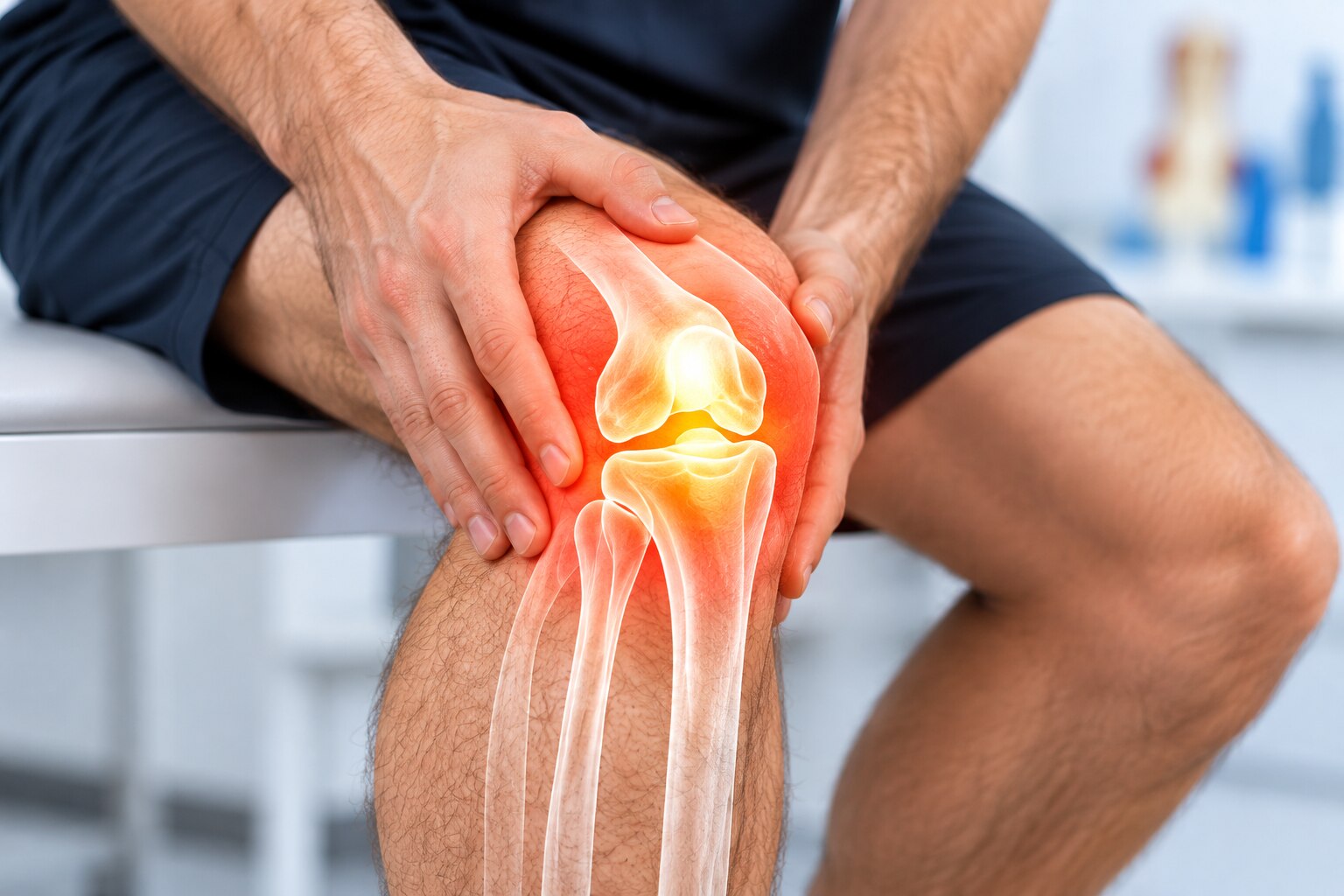
Knee pain can begin after a twist, build gradually with repeated loading, or signal inflammation, infection, or pain referred from the hip or spine. By the end, you will be able to match common symptom patterns to possible causes, recognise warning signs, and compare evaluation and treatment options without assuming that every painful knee needs surgery.
Key takeaways
- Sudden pain after a twist or fall needs assessment for internal knee damage.
- Seek urgent care for a hot, swollen knee, fever, deformity or inability to bear weight.
- Exercise therapy improves strength and function for many knee pain conditions.
- Surgery depends on the injury, symptoms, functional loss and response to treatment.
What pattern of knee pain points to each common cause?
Pain location, timing and associated symptoms narrow the possibilities, but no symptom pattern proves a diagnosis. Pain that begins gradually with activity suggests overuse or degeneration; sudden pain after a twist, fall or impact raises concern for internal damage.
- Osteoarthritis: aching across the knee, stiffness after rest, and pain with walking or stairs develop gradually. Swelling is usually mild and comes and goes.
- Patellofemoral pain syndrome: pain around or behind the kneecap worsens with running, squats, stairs or prolonged sitting.
- Meniscus tears: pain along the inner or outer joint line follows twisting and may cause catching, clicking or delayed swelling over 24 to 48 hours.
- ACL injuries and other ligament injuries: a pop, immediate swelling within hours, instability or difficulty changing direction after trauma points to a significant internal injury.
- Tendinitis or bursitis: pain is localised to a tendon or pressure point and worsens with repeated loading or kneeling, rather than causing true locking.
- Gout or rheumatoid arthritis: intense pain, warmth and swelling can affect the whole joint; gout often starts suddenly, while rheumatoid arthritis commonly affects several joints with prolonged morning stiffness.
- Referred hip or spine pain: pain may reach the knee without knee swelling, alongside hip movement problems, back pain, numbness or weakness.
A deformed knee, inability to bear weight, a locked joint, rapidly increasing swelling, or severe post-injury pain needs prompt assessment. A hot red knee with fever or a swollen calf is urgent because infection or a clot can threaten your health.
When does knee pain need urgent assessment, and how is it diagnosed?
Seek urgent medical care after a significant injury if you have a deformed knee, inability to bear weight, a locked joint, severe pain, or rapidly increasing swelling. A hot, red, very painful knee needs same-day assessment, especially with fever, chills or feeling unwell, because septic arthritis can rapidly damage cartilage.
Calf swelling or pain also needs prompt evaluation, particularly with breathlessness or chest pain.
- Arrange urgent assessment for suspected fracture, dislocation, major ligament injury or joint infection.
- Do not force a locked knee or try to straighten a deformed knee.
- Seek immediate emergency help for chest pain or sudden breathlessness accompanying calf swelling.
A clinician will compare both knees, check alignment, warmth, swelling, tenderness and range of motion, then assess ligament stability, meniscus signs, muscle strength, walking pattern and hip or spine causes. The examination helps decide which investigation could change treatment.
| Assessment or test | What it can show | Important limitation |
|---|---|---|
| Clinical examination | Instability, restricted movement, effusion or typical osteoarthritis | Findings can overlap between conditions |
| X-ray | Fracture, joint-space narrowing and osteophytes | Structural severity often correlates poorly with pain |
| MRI | Selected meniscus, ligament, cartilage or other internal injuries | Not routine; incidental abnormalities are common |
| Joint aspiration | Fluid cell count, Gram stain, culture and crystals | Crystals support gout or pseudogout but do not exclude infection |
For a typical osteoarthritis pattern, symptoms and examination often provide the diagnosis without routine imaging. Blood tests alone cannot rule out infection; a suspicious hot joint requires synovial-fluid testing.
Which non-surgical treatments improve knee pain and function?
Tailored non-surgical care improves pain and function by reducing harmful load while rebuilding strength. Keep moving, but change the activity that provokes symptoms rather than stopping completely.
| Option | What it does | When it applies |
|---|---|---|
| Activity modification | Reduces painful loading while preserving fitness | For patellofemoral pain after stairs, squats, running or sitting; tendon pain after a sudden training increase |
| Therapeutic exercise | Builds muscle capacity and joint control | For osteoarthritis and most persistent knee pain; progress gradually instead of resting for weeks |
| Hip and knee strengthening | Improves kneecap tracking and lower-limb control | Especially useful for patellofemoral pain |
| Weight loss for knee osteoarthritis | Reduces load during walking and daily tasks | If you are overweight or living with obesity; any loss can help, and 10% usually helps more than 5% |
| Heat or ice | Heat eases stiffness; ice can reduce pain after activity or swelling | Choose the response that helps, protecting skin and limiting each application to about 15–20 minutes |
| Braces or taping | Adds support or changes force around the knee | Braces may help instability or selected osteoarthritis; taping can give short-term relief in some patellofemoral pain |
| Walking aids | Transfers some weight from the painful leg | A correctly fitted cane or crutch helps when pain makes walking unsafe or causes a limp |
Supervised rehabilitation can help you start and maintain exercise. A brace, tape or foot orthosis is an aid, not a cure, and persistent locking, instability or swelling needs reassessment.
What medicines and injections can relieve knee pain, and what are their limits?
Topical NSAIDs are often the first medicine tried for knee osteoarthritis. Applied to the painful area, they can reduce pain with less whole-body exposure than tablets. Do not apply them to broken skin, and ask a clinician or pharmacist if you have an NSAID allergy.
| Option | Useful when | Limits and safety |
|---|---|---|
| Topical NSAIDs | Localised osteoarthritis pain | Relief may be incomplete; follow the product’s dose and duration |
| Oral NSAIDs | Pain not controlled by topical treatment, when inflammation is prominent | Can cause stomach bleeding, kidney injury, fluid retention and cardiovascular problems |
| Corticosteroid injection | A painful arthritic flare limits walking or exercise | Relief is temporary, typically about 2 to 10 weeks; it does not repair the joint |
Oral NSAIDs need clinician advice if you have kidney disease, stomach ulcers, heart or liver disease, are pregnant, are older, or take blood thinners. Do not combine two NSAIDs, such as ibuprofen and naproxen, unless specifically instructed.
A corticosteroid injection should not replace strengthening, activity adjustment or weight management. A hot, red, swollen knee with fever needs infection assessment before injection; gout crystals in joint fluid do not exclude infection. Repeated injections require review because short-term relief can create a cycle without addressing the underlying problem.
When are arthroscopy, ligament surgery or knee replacement considered?
Surgery is justified by the problem you have and its effect on daily life, not by an X-ray alone. Clinicians combine your history, examination and, when needed, X-ray or MRI findings with your response to non-surgical treatment.
A rapidly swollen knee after trauma needs prompt assessment because an ACL rupture, fracture or patellar dislocation may require different treatment.
- Arthroscopy is not a routine treatment for osteoarthritis: lavage or debridement has not produced lasting, meaningful benefit. It may be appropriate for a true locked knee, where a displaced fragment prevents movement, or for selected traumatic injuries.
- ACL reconstruction is considered when a confirmed tear causes repeated giving-way, prevents work or sport, or accompanies repairable meniscal or other ligament damage. Rehabilitation demands and activity goals matter; an ACL tear does not automatically require surgery.
- Knee replacement indications include severe, persistent pain, stiffness or loss of function that substantially reduces quality of life despite appropriate exercise, medicines and other conservative care. Discuss rehabilitation time, infection, blood clots, stiffness and the possibility of ongoing pain before deciding.
When the diagnosis or treatment choice remains uncertain, ALTIUZ HOSPITAL can provide coordinated orthopaedic assessment with rehabilitation planning, helping match examination findings and imaging to a realistic recovery plan. A second opinion is sensible before irreversible surgery.
Related services
ORTHOPAEDIC ORTHOPAEDIC Common areas in orthopaedics include: Fractures and dislocations Arthritis and joint problems (like knee and hip replacements) Back and spine... |
RHEUMATOLOGIST RHEUMATOLOGIST What is Rheumatology? Rheumatology is a medical specialty focused on diagnosing and treating rheumatic diseases — conditions that affect joints,... |
Frequently asked questions
What pattern of knee pain points to each common cause?
Gradual pain with activity can suggest overuse or osteoarthritis, while sudden pain after twisting, falling or impact raises concern for ligament, meniscus or bone injury. Pain location, timing, swelling, locking and instability help guide assessment, but no pattern proves a diagnosis.
When does knee pain need urgent assessment, and how is it diagnosed?
Seek urgent assessment for a deformed knee, inability to bear weight, a hot swollen joint with fever, severe pain after an injury, or a locked knee. Diagnosis uses your history, physical examination and, when indicated, X-rays, ultrasound or MRI.
Which non-surgical treatments improve knee pain and function?
Treatment can include activity modification, physiotherapy, strengthening and flexibility exercises, weight management when relevant, ice or heat, supportive devices and gradual return to activity.
What medicines and injections can relieve knee pain, and what are their limits?
Paracetamol and anti-inflammatory medicines can reduce pain for selected patients, but they do not repair structural damage and anti-inflammatories carry risks. Injections such as corticosteroids may provide temporary relief; suitability depends on your health and diagnosis.
When are arthroscopy, ligament surgery or knee replacement considered?
Arthroscopy is reserved for selected problems rather than routine arthritis pain. Ligament surgery is considered for persistent instability or high functional demands, while knee replacement is considered for severe arthritis causing ongoing pain and disability despite non-surgical treatment.
Related service
PHYSIOTHERAPY PHYSIOTHERAPY What is Physiotherapy? Physiotherapy (or physical therapy) is a healthcare profession that helps people restore, maintain, and improve physical... |