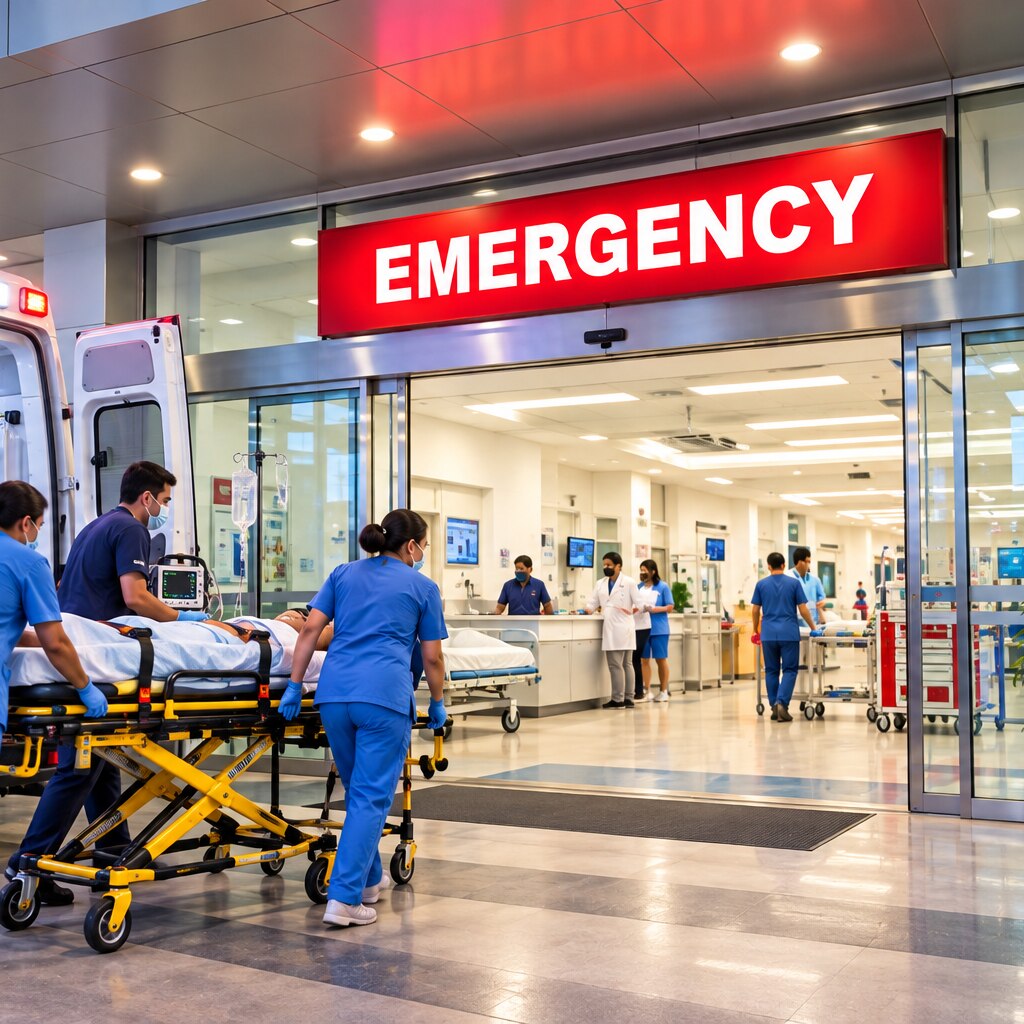
The right emergency hospital is the one that can deliver the needed treatment fastest, not automatically the biggest or most highly rated facility. You will learn how to judge symptoms, call for transport, compare hospital capabilities, account for Mumbai traffic and access, and arrive prepared without delaying care.
Key takeaways
- Call an ambulance for breathing, circulation, brain-function warning signs or major trauma.
- Give Mumbai emergency services your exact location, landmark, symptoms and callback number.
- Check 24-hour emergency care, ICU access, specialists, imaging, blood bank and surgery support.
- Choose diagnosis-specific capability over ratings when minutes and treatment access matter.
Which symptoms need an ambulance, emergency-department care or an appointment?
Call an ambulance for medical emergency warning signs that threaten breathing, circulation or brain function. These include chest pressure, severe breathlessness, stroke symptoms—facial drooping, one-sided weakness or sudden confusion—uncontrolled bleeding, a seizure lasting more than five minutes, loss of consciousness, poisoning, major trauma or serious burns.
Do not drive someone who is unconscious, confused, struggling to breathe or rapidly worsening.
| Option | What it means | When it applies |
|---|---|---|
| Ambulance | Immediate response and emergency transport | Any life-threatening warning sign, suspected stroke, cardiac event, severe injury or rapidly deteriorating illness |
| Emergency department now | Go for assessment without waiting for a clinic appointment | New severe abdominal pain, persistent vomiting with dehydration, high fever with confusion, a deep wound, a worsening asthma attack, or symptoms that feel serious but are currently stable |
| Urgent outpatient appointment | Prompt clinical review, but no immediate danger | A mild, stable problem such as a recurring rash, controlled joint pain, a lingering cough without breathlessness, or medication side effects without fainting or severe symptoms |
For suspected stroke, note the exact time the person was last known well; treatment decisions depend on it. If you cannot judge the severity, choose emergency assessment rather than waiting for an appointment. Avoid food, drink and unprescribed medicine when swallowing is impaired or consciousness is reduced.
What should you do when calling emergency services in Mumbai?
Call Mumbai emergency number 112 for an urgent response, or ambulance 108 for emergency transport. Give the address, building entrance, landmark, callback number and the patient’s exact location.
Do not drive someone who is unconscious, struggling to breathe, having a seizure, showing stroke signs, or bleeding heavily; an ambulance crew can start treatment and alert the receiving hospital.
Give the dispatcher this emergency dispatcher information:
- Patient’s age, symptoms, when they began, and whether the patient is conscious and breathing normally
- The number of patients and any fire, traffic, electrical or chemical danger
- Known heart disease, diabetes, pregnancy, allergies, medicines and blood thinners
- What first aid you have already given
Stay on the line and follow instructions. Unlock the entrance, send someone to guide the crew, and keep medicines and identification ready.
For CPR, place an unresponsive person who is not breathing normally on a firm surface and start hard, fast chest compressions in the centre of the chest at 100–120 per minute. Use an automated external defibrillator if available and follow its prompts.
If the person is unconscious but breathing normally, use the recovery position, unless moving them risks worsening a major injury. For bleeding first aid, press firmly with cloth or gauze; do not remove an embedded object. Avoid food, drink and un####
Which hospital capabilities matter more than size or ratings?
A nearby hospital can provide definitive emergency care only if it can deliver the intervention, not merely receive and stabilise the patient. Ask whether its 24/7 emergency department has resuscitation equipment, doctors on site, operating-theatre access, imaging, laboratory testing, blood-bank support and staffed transfer arrangements.
Check these points before an emergency, or ask the ambulance service to confirm them:
- Is there an adult, paediatric, neonatal, cardiac, neurosurgical, burns or transplant intensive care unit relevant to the patient?
- Does the intensive care unit include ventilators, invasive monitoring and round-the-clock critical-care doctors?
- Is a coronary care unit linked to emergency angiography and percutaneous coronary intervention?
- Does the trauma service provide 24-hour surgical cover, urgent imaging and blood products?
- Can the hospital measure lactate, obtain blood cultures, give rapid antibiotics, provide fluids and vasopressors, and admit septic-shock patients?
- If a required service is unavailable, does a staffed transfer centre arrange critical-care transport to a named facility?
| Capability | What to verify | What failure looks like |
|---|---|---|
| 24/7 emergency department | On-site clinicians and resuscitation team | Initial stabilisation followed by an unplanned transfer |
| Specialist critical care | Correct ICU type and consultant backup | An ICU bed exists but cannot manage the diagnosis |
| Definitive treatment | PCI, emergency surgery, stroke imaging or burns care | Routine consultation replaces immediate intervention |
| Transfer system | Formal referral network and critical-care transport | Families must find another hospital themselves |
Whether you are checking ALTIUZ HOSPITAL or another facility, ask for the exact service available tonight—not a general statement that specialists provide routine consultation.
How should distance, traffic and diagnosis-specific treatment affect your choice?
Choose the destination by minutes to definitive treatment, not the shortest road distance. Compare hospital travel time from the patient to an ambulance entrance, then ask whether that hospital can deliver the intervention without transfer. Traffic can erase a nominal advantage; ambulance dispatch may route the patient to a better-equipped centre.
| Emergency | What to compare | When it applies |
|---|---|---|
| Stroke | A staffed stroke pathway, immediate CT, intravenous thrombolysis and mechanical thrombectomy access | Sudden facial droop, one-sided weakness, speech loss or confusion |
| STEMI | 24-hour coronary angiography and PCI capability; targets are 90 minutes for direct PCI arrival and 120 minutes when transfer is required | Suspected heart attack with persistent chest pressure or ECG-confirmed ST elevation |
| Sepsis | Rapid lactate testing when indicated, blood cultures, antibiotics, fluids, vasopressors and specialist intensive care | Shock, confusion, very low blood pressure or suspected infection with organ failure |
| Transfer need | A staffed transfer centre, critical-care transport and a formal referral network | The patient may need surgery, interventional radiology, burns care, ECMO or specialist paediatric care |
For suspected stroke or STEMI, a smaller hospital that provides definitive treatment may be safer than a larger hospital that only stabilises patients. Ask how often transfers leave, where patients go, and whether specialists are available at the hour you arrive.
For sepsis, confirm that intensive-care staff can monitor blood pressure, breathing and urine output and start vasopressors when fluids are unsuitable or insufficient. Do not choose on accreditation alone: it shows assessment against a standard, not guaranteed access or outcomes for your diagnosis.
What should you bring, verify and ask before choosing a nearby hospital?
Bring medical emergency documents in a phone folder and paper copy: identification, a medication list, allergies, diagnoses, prior discharge summaries, advance directives, insurance details and an emergency contact. Pack current medicines in original labelled containers, including insulin, inhalers and anticoagulants; do not give extra doses unless clinicians instruct you.
Ask these questions before admission, or have a relative ask them:
- Is the blood bank open 24 hours, and can laboratory and imaging results be delivered urgently?
- Are anaesthesia, surgery, cardiology, neurology, obstetrics, paediatrics and radiology physically present or on-call overnight?
- Does the hospital provide the relevant adult, paediatric, cardiac, neurosurgical or neonatal intensive care?
- After stabilisation, can pharmacy staff reconcile medicines, and are fall prevention, delirium screening, disability communication and discharge planning available?
- What formal transfer network, staffed transfer centre and critical-care transport access apply if the patient needs burns care, interventional radiology, ECMO or specialist surgery?
Use evidence, not department names alone:
| Indicator | What to verify | What it tells you |
|---|---|---|
| Accreditation | Which accreditation standard and current validity | External process assessment, not guaranteed outcomes |
| Emergency diagnostics | 24-hour CT, urgent laboratory testing and prompt image interpretation | Speed of diagnosis |
| Specialist backup | Named overnight in-house or on-call clinicians | Whether definitive treatment is available |
| Transfer network | Written referral routes and transport arrangements | Safety when local capability ends |
Frequently asked questions
Which symptoms need an ambulance instead of an appointment?
Call an ambulance for severe breathlessness, chest pressure, stroke signs such as facial drooping or one-sided weakness, uncontrolled bleeding, loss of consciousness, poisoning, major trauma, serious burns or a seizure lasting more than five minutes. Use an appointment for stable symptoms without emergency warning signs.
What should you tell emergency services in Mumbai?
Give your callback number, exact address, nearest landmark, patient’s age, symptoms, when they began and immediate dangers such as fire or traffic. Keep the phone available for follow-up instructions.
Which hospital capabilities matter for critical medical needs?
Check for a 24-hour emergency department, intensive care, emergency imaging, laboratory testing, blood-bank access, operating-room support and specialists relevant to the condition. Confirm whether those services are available on site at the time of treatment.
How should distance and traffic affect your hospital choice?
Compare travel time during current traffic with the hospital’s ability to treat the suspected condition. A nearby facility with no required specialist, ICU bed or emergency imaging may delay transfer and definitive treatment.
What should you verify before choosing a nearby hospital?
Ask whether emergency care operates 24 hours, which specialists and diagnostic services are on site, how transfers work, whether a caregiver can accompany the patient and which identification or medical records to bring.